
AGELAIOS is the missing interoperability layer that unifies hardware and software for seamless continuity of operations

Every programme rebuilds the same plumbing: a format bridge here, a radio driver there, a fusion loop somewhere else, each one written for a single platform and thrown away with it. We build that layer once, against published standards, so it does not have to be written again for the next sensor, the next airframe, the next coalition.

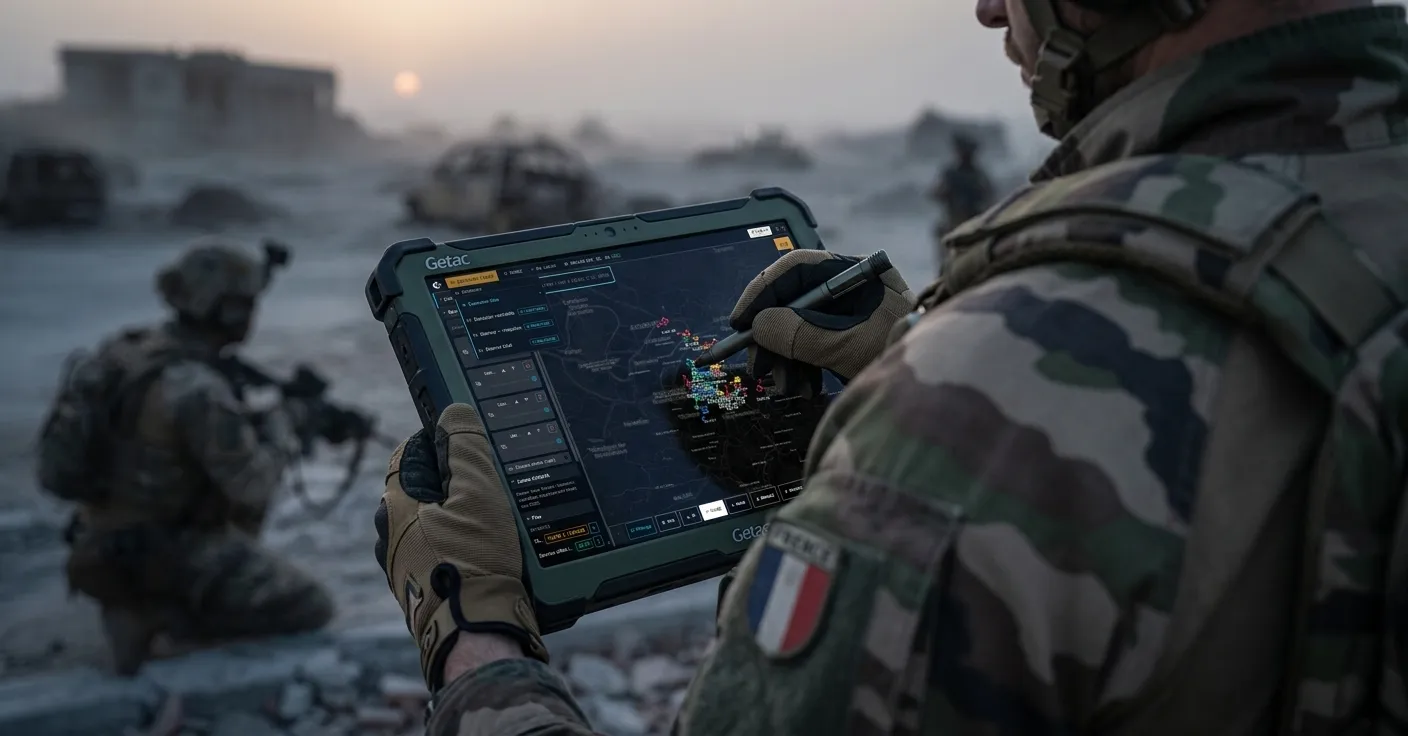
Rugged tablet displaying the AGELAIOS tactical interface.

in action

Scenario 1 Discover how we enable seamless allied cooperation to mitigate hostile drone swarms.

  1. 01 Sighting

    It all starts at the forward edge

    A coalition scout, deployed forward with an allied unit, watches a hostile swarm cross his sector. His binoculars run AGELAIOS and are wired to a tactical data radio. Whatever he sees instantly becomes a shared track on the coalition network.

    This node's AGELAIOS build

    Binocular node

    Service Function Standard
    tac-adapter Sighting encoded as a track Cursor-on-Target
    fusion Track identity and lifecycle STANAG 4676
    Radio vendor driver Wired link down to the tactical radio Proprietary API

    What it buys Binoculars running AGELAIOS produce confidence-ranked tracks and broadcast them natively to the coalition, in EMCON-controlled bursts and under a strict share-control policy.

  2. 02 Uplink

    The radio opens the link

    His binoculars are wired to the tactical radio lying beside him. The link opens, and the sighting leaves on the net as a track, not as a voice call someone has to write down.

    Sharing and emission

    The radio is a bearer, not an AGELAIOS node. What may leave is settled before the track reaches it: every track carries a release marking, and the sharing policy names the coalition partners cleared to receive it. Emission control is enforced at the same point. Under a restricted posture, the node transmits only within its budget for that bearer and inside planned windows, and what cannot leave is stored for the next one.

  3. 03 Rear post

    The track walks up the radio

    The report climbs the tactical net to a unit held further back. Its tablet runs the same software on the same track, and shows it for what it is so far: a low-confidence potential threat.

    This node's AGELAIOS build

    Tablet

    Service Function Standard
    symbol Symbol drawn from the track APP-6(E), MIL-STD-2525D
    fusion One identity, one track STANAG 4676

    What it buys The track keeps one identity from the sensor to the tablet. Symbol and confidence are drawn from the track itself, so the rear post reads what the scout reported instead of transcribing it.

  4. 04 Corroboration

    A second sensor agrees

    The swarm enters the field of a tripod radar, itself an AGELAIOS node, wired to the tablet over a few dozen metres of ethernet. Two sensors, two bearers, one track, and the confidence firms up.

    This node's AGELAIOS build

    Tripod radar

    Service Function Standard
    Radar vendor app Target reports off the antenna STANAG 4607 GMTI
    fusion Two bearers merged into one track STANAG 4676

    What it buys A second sensor does not open a second track. The radar reports are merged into the one the scout opened, so what rises is the confidence and not the number of contacts on the map.

  5. 05 Reconciliation

    The reconciled track goes up

    The operator is shown a single view: two sensors, one track, one confidence. The tablet sends that reconciliation to theatre C2 over its own satellite link, direct to satellite in this example, without waiting for a rear relay.

    This node's AGELAIOS build

    Tablet

    Service Function Standard
    fusion Two sensors reconciled into one track STANAG 4676
    export-guard Release marking before it leaves FMN profile
    jetstream-gwd Track carried to theatre C2 NATS JetStream

    What it buys The track that theatre C2 receives is the one the scout opened, with its confidence and its release marking attached. Nothing rewrites it on the way up.

  6. 06 Decision

    The track joins the theatre picture

    Forty kilometres back, the theatre command post takes the uplink in. The track arrives with its identity, its confidence and its release marking already attached, and the theatre picture folds it in instead of opening it again.

    This node's AGELAIOS build

    Theatre command post

    Service Function Standard
    jetstream-gwd Track received from the forward nodes NATS JetStream
    fusion Forward tracks folded into the theatre picture STANAG 4676
    tac-adapter Situation and order reports ADatP-3, APP-11

    What it buys What theatre C2 holds is a best-effort reconstruction: every track and report the combat mesh could carry, reconciled rather than stacked. The fire order then travels back down the same path.

  7. 07 Launch

    The operator releases the interceptor

    The fire order weighed at theatre C2 comes back down to the tablet that raised the track. An interceptor waits vertically on its rail; the operator executes the order and commits it. Motors spin up, and it goes.

    This node's AGELAIOS build

    Launch rail

    Service Function Standard
    UAS vendor app Interceptor released STANAG 4586 DLI
    driver Flight commands, bounded MAVLink

    What it buys Native interoperability lets the airframe vendor connect straight into the coalition net, securely, and receive the reconciled tracks. The interceptor leaves the rail already loaded with its targets.

  8. 08 Pack

    Two wingmen join, and they mesh

    Two more airframes take the flanks. A 2.4 GHz link ties the three together, with no server and no ground relay in the loop. The pack turns onto the swarm.

    This node's AGELAIOS build

    Interceptor

    Service Function Standard
    bus Node to node, no server in the loop zenoh
    fusion One picture across the pack STANAG 4676
  9. 09 Jamming

    The link breaks, then comes back

    The pack crosses a hostile jammer. The inter-airframe link tears while they are in the beam. Past the zone, it rebuilds itself, and nobody had to re-pair anything.

    This node's AGELAIOS build

    Interceptor

    Service Function Standard
    bus Link torn, then re-formed alone zenoh
    fusion Track held while the link is down STANAG 4676
  10. 10 Relay

    One airframe carries the others

    Far enough out, the pack drops off the command network but keeps talking to itself. The right wingman has a miniature satcom antenna: it takes the relay and feeds the other two.

    This node's AGELAIOS build

    Wingman relay

    Service Function Standard
    jetstream-leafd On-board satcom relay NATS JetStream
    coalition Export filtered at the edge FMN profile
  11. 11 Interception

    Two targets, two engagements

    The pack closes on the swarm and engages. The track that started as a pair of binoculars ends here.

    This node's AGELAIOS build

    Interceptor

    Service Function Standard
    driver Terminal engagement command STANAG 4586 DLI
    tac-adapter Result reported as a track Cursor-on-Target

Standards

Your standards, already on board.

NATO, NIST, ANSSI, OGC, IETF: AGELAIOS speaks the language of your theaters, your allies and your auditors. 84 standards covered across 14 domains, each with an owned, acceptance-verified status, with no brochure compliance.

[ 01 ] Geodesy & mapping 10 standards
  • WGS-84 (STANAG 2211)

    reference datum for all positions (EPSG:4326), Web Mercator for tiling

    Compliant

  • MGRS · UTM · GEOREF

    military grids, multi-format conversion and input (DMS, decimal, Maidenhead)

    Compliant

  • STANAG 3809 (DTED) · MIL-PRF-89020

    elevation levels 0/1/2 and SRTM, line of sight, viewshed, terrain navigation

    Compliant

  • OGC WMTS (WebMercatorQuad)

    tile service consumable by any third-party OGC client

    Compliant

  • OGC API Features · WMS 1.3.0 · WFS 2.0.0

    served and tested; arbitrary-extent resampling deferred

    Partial

  • GeoPackage (OGC 12-128r)

    read at ingestion

    Partial

  • OGC 3D Tiles · Cesium quantized-mesh 1.0

    3D tiled terrain served from the DEM layer

    Compliant

  • STAC 1.0.0

    spatiotemporal catalog served, IDs carried by map packages

    Compliant

  • PMTiles v3 · MBTiles · MVT

    offline formats: read, write, serve and render

    Compliant

  • GDAL · PROJ

    dataset preparation tooling (gdal_translate, tippecanoe); on-the-fly PROJ reprojection planned

    Partial

[ 02 ] Cryptography 10 standards
  • FIPS 204 (ML-DSA-65)

    post-quantum signature, NIST level 3, KAT/POST self-tests

    Aligned

  • FIPS 203 (ML-KEM) · X25519MLKEM768

    hybrid key exchange on the mesh, hardened require_pqc mode

    Aligned

  • NSA CNSA 2.0

    ML-DSA / ML-KEM choices and hybrid agility consistent with the roadmap

    Aligned

  • FIPS 186-5 · RFC 8032 (Ed25519)

    classical signature and branch of the hybrid mode

    Compliant

  • FIPS 140-3 · CMVP

    frozen crypto module and self-tests shipped; external lab validation not engaged

    Partial

  • FIPS 180-4 · FIPS 197 · FIPS 202

    SHA-256 for standardized integrity, XTS-AES for encryption at rest (LUKS2)

    Compliant

  • BLAKE3

    high-performance internal hashing, outside the FIPS catalog: accepted choice

    Accepted deviation

  • TLS 1.3 (RFC 8446)

    mTLS anchored on the fleet CA, hybrid post-quantum handshake

    Compliant

  • RFC 9106 (Argon2)

    argon2id in PHC format for local passwords

    Compliant

  • RFC 6238 (TOTP)

    optional second factor

    Planned

[ 03 ] System security & evaluation 9 standards
  • UEFI Secure Boot · TPM 2.0 (ISO/IEC 11889)

    verified and measured boot, PCR sealing; without TPM, explicit degraded posture

    Compliant

  • fs-verity · IMA · dm-verity

    measured integrity of images and Driver Store, SHA-256 Merkle root

    Compliant

  • NIST SP 800-207 (Zero Trust) · SP 800-53

    deny-by-default on the bus, declarative capabilities, RBAC, audited gating; formal SP 800-53 mapping not produced

    Aligned

  • Bell-LaPadula · Biba (multiniveau de sécurité)

    security lattice, no-read-up / no-write-down, Biba integrity, capability + MAC mediation shipped and tested; label attachment to resources deferred

    Partial

  • NIST SP 800-88 rev.1

    crypto-erase by key destruction, graded scope, erasure certificate

    Aligned

  • Common Criteria (ISO/IEC 15408) · ISO/IEC 18045

    security target written (TOE, SFRs, target EAL); external lab evaluation

    Partial

  • CSPN (ANSSI)

    CSPN target and evaluator test plan written; external evaluation

    Partial

  • RGS (ANSSI)

    qualification dossier and tested compliance guard; external qualification

    Partial

  • RFC 8785 (JSON Canonicalization)

    canonical form for audit chaining and profile fingerprints

    Aligned

[ 04 ] Fleet PKI & software supply chain 5 standards
  • X.509 (RFC 5280)

    fleet CA, chain validation, CRL, mDNS and IP SANs

    Compliant

  • The Update Framework (TUF)

    four roles and delegations, key rotation, anti-rollback, root keys in HSM

    Compliant

  • SPDX (ISO/IEC 5962) · CycloneDX

    per-package SBOM, signed build provenance with CVEs and licenses

    Compliant

  • SLSA · NIST SSDF (SP 800-218)

    bit-for-bit reproducible build, signed provenance; formal SLSA attestation not produced

    Aligned

  • NIST NVD / CVE

    cve-check at build, CVEs recorded in image provenance

    Aligned

[ 05 ] Tactical tracks & ISR 5 standards
  • STANAG 4676 (NATO ISR Tracking)

    track model, lifecycle, affiliation; extension point wired (Covariance Intersection, kinematics), greedy correlation unchanged bit-for-bit

    Aligned

  • STANAG 4607 (GMTI)

    dwell and target-report parsing into tracks, fed to the bus pivot

    Partial

  • STANAG 4545 (NSIF)

    secondary imagery, ICORDS/IGEOLO georeferencing

    Partial

  • STANAG 7023 (imagerie primaire)

    ingestion into objects; pixel decoding deferred

    Partial

  • STANAG 4559 (NSILI)

    query client for third-party ISR libraries, BQS queries

    Partial

[ 06 ] Video & media 6 standards
  • UIT-T H.264 · H.265 + RFC 6184 · RFC 7798

    real codecs and compliant RTP packetization

    Compliant

  • H.266/VVC (RFC 9328)

    RTP packetization and NAL parsing shipped; pixel decoding deferred, clean fallback

    Partial

  • STANAG 4609 · MISB ST 0601/0102 (KLV)

    georeferenced video metadata; media chain in place, KLV muxing to be wired

    Planned

  • UIT-R BT.601/709/2020/2100 · SMPTE P010/V210

    SDR/HDR colorimetry, 10/12/16-bit paths

    Compliant

  • GigE Vision · GenICam · PFNC

    industrial camera acquisition GVCP/GVSP, source to encoding

    Compliant

  • OpenTelemetry · W3C Trace Context · Parquet

    OTLP observability, columnar export with bounded retention

    Compliant

[ 07 ] Symbology & tactical graphics 3 standards
  • APP-6(D/E) (STANAG 2019)

    frames, affiliation, dimension, echelon; full SIDC decoding, fine iconography out of scope

    Aligned

  • MIL-STD-2525C/D

    letter and numeric SIDC forms, pivot referenced on 2525D

    Aligned

  • NVG (NATO Vector Graphics)

    tactical overlay import/export (points, lines, polygons), advanced styling out of scope

    Partial

[ 08 ] C2 interoperability & messaging 4 standards
  • Cursor-on-Target · TAK Protocol v1

    bidirectional CoT XML and protobuf, TAK bridge with fail-closed mTLS, out of the box

    Compliant

  • STANAG 5525 (JC3IEDM / MIP)

    replication gateway from pivot to JC3IEDM, serializable DEM batch

    Partial

  • ADatP-3 · APP-11 (FORMETS)

    POSREP and SITREP encoded and decoded; full catalog out of scope

    Partial

  • FMN · NATO NISP

    building blocks of a coalition profile; spiral enrollment not engaged

    Aligned

[ 09 ] Civil & dual-use sources 9 standards
  • GeoJSON (RFC 7946)

    Feature and FeatureCollection with Point geometry, bidirectional, longitude-latitude order honoured

    Compliant

  • NMEA-0183

    GGA, RMC and GLL position sentences decoded, checksum verified; inbound-only feed

    Compliant

  • APRS (TNC2)

    uncompressed-position packets decoded into friendly pivots; compressed formats out of scope

    Partial

  • ADS-B (dump1090 / readsb · OpenSky)

    aircraft state vectors decoded into neutral pivots, feet and knots converted to SI units

    Compliant

  • AIS · AISStream.io

    type 1 position reports decoded with MMSI, course and speed; full message catalog out of scope

    Partial

  • GTFS-Realtime

    VehiclePosition protobuf decoded into a neutral rail vehicle, carrying heading, speed and timestamp

    Compliant

  • DATEX II

    point road situations decoded into neutral ground events; non-point records skipped without error

    Partial

  • TLE · propagation SGP4

    orbital elements propagated into neutral space objects, fidelity pinned on the Vallado reference vector

    Compliant

  • USGS · GDACS · Global Fishing Watch

    earthquakes, multi-hazard and vessel behaviour fed as neutral pivots with the expected domain SIDC

    Compliant

[ 10 ] Classification & coalition 4 standards
  • STANAG 4774 / ADatP-4774

    confidentiality labels, releasability, caveats, fail-safe composition, XML profile shipped

    Aligned

  • STANAG 4778 / ADatP-4778

    cryptographic label-to-data binding, XML binding with tamper detection

    Aligned

  • IGI 1300 (SGDSN)

    mapping to national levels, permanent banner, downgrade under dual validation, multi-level core shipped and tested

    Aligned

  • II 901 (SGDSN)

    encryption at rest, mTLS, tamper-evident audit: properties of a restricted-level system

    Aligned

[ 11 ] Drones & effectors 3 standards
  • MAVLink

    v1/v2 frames, CRC-16/X.25, PX4 and ArduPilot, standard integration path

    Compliant

  • STANAG 4586

    DLI driver (codec, LOI grading, safety envelope); socket egress at the daemon

    Partial

  • ONVIF (Profile S/T)

    PTZ camera and gimbal control

    Aligned

[ 12 ] Links & timing 4 standards
  • STANAG 5066 (HF)

    SIS/ALE connector for third-party HF interop; transport-agnostic agelaios-wire point to point

    Partial

  • UIT-R P.525 · P.526 · P.833

    first-order link budget: FSPL, diffraction, refraction, vegetation

    Aligned

  • Longley-Rice / ITM · deux-rayons

    advanced band-calibratable models, tested against numeric oracles

    Partial

  • NTP (RFC 5905) · NTS (RFC 8915) · PTP (IEEE 1588)

    disciplined time sources, GNSS included

    Aligned

[ 13 ] Mission AI 4 standards
  • Principes OTAN d’IA responsable (2021)

    strict human-in-the-loop, marked provenance and confidence, no automatic kinetic chain

    Aligned

  • Règlement (UE) 2024/1689 (AI Act)

    military use out of scope; transparency, human control and traceability applied by choice

    Aligned

  • ISO/IEC 42001 · 23894 · TR 24028

    AI management system formalized, tested model-admission guard; external certification audit

    Partial

  • Avis du Comité d’éthique de la défense (France)

    national doctrine on autonomy in weapon systems: human control required, automatic engagement forbidden

    Aligned

[ 14 ] Engineering, documentation & accessibility 8 standards
  • W3C WCAG 2.2 (niveau AA)

    AA contrast on four themes, field-grade touch targets, prefers-reduced-motion

    Compliant

  • W3C CSP Level 3

    default-src self, module widgets in null-origin iframes

    Compliant

  • WebAssembly · WASI

    portable isolation floor, wasm32-wasip2 targets

    Compliant

  • BCP-47 · Unicode CLDR

    locale resolution, plurals, right-to-left writing

    Compliant

  • RG Aéro 000 40/42 · AQAP 2110/2210

    codified specification, requirement-to-test traceability, proof by automated test

    Aligned

  • ISO/IEC/IEEE 12207 · 15288 · ISO/IEC 25010

    lifecycle and quality characteristics treated as verifiable requirements

    Aligned

  • ASD S1000D (Issue 5.0)

    single Markdown source converted into a schema-validated CSDB (433 data modules, one publication module), manual and embedded publication built from the same base

    Partial

  • ISO/IEC 27001 · ISO 9001

    information-security and quality management systems: owned by the operating organization, outside the product’s technical scope

    Planned

The model

Two editions, one architecture

Standard is the core edition for embedded integration and dual-use deployment. Defence extends the same software baseline with operational sustainment, security support and compliance with military standards, including STANAG. The transition is managed as an upgrade, with no separate porting effort.

Standard Edition

Apache 2.0, public

The node platform, and everything a civil or dual-use integration asks for.

  • Node platform: signed isolated modules, hardware arbitration, atomic updates
  • Tactical adaptation layer: Cursor-on-Target, NMEA-0183, GeoJSON, APRS
  • Civil and dual-use feeds: AIS, ADS-B, GTFS-Realtime, DATEX II, crisis feeds
  • COP as a cartographic viewer, docking and public administration panels
  • Node discovery and fleet management on an open model, MAVLink drivers

The code will be published once export control clearance is granted. Until then, access is opened case by case: write to us

Defence Edition

Closed, per programme

What a defence programme adds on top, under its own instruction.

  • NATO interoperability: STANAG 4586, 4607 and 4676, JC3IEDM and MIP gateway
  • Tactical COP layers: tracks, fusion, threat rating, terrain
  • APP-6 and MIL-STD-2525 symbol sets, carried as a module
  • Fleet key infrastructure, post-quantum mesh, coalition export control
  • Homologation file, export-control dossier, programme support